By the end of this piece, you’ll be able to tell whether your application has a real performance problem worth solving, or whether you’re about to spend real engineering time chasing a problem that isn’t really there for your users. That distinction — optimizing because the numbers say you should, versus optimizing because it feels like the responsible thing to do — is the one teams get wrong most often, reaching for techniques like memoization, code splitting, and virtualization as a blanket best practice rather than as a response to a verified, measured need.
Why This Question Deserves Honest Consideration
Every technique covered throughout our other guides — memoization, code splitting, virtualization, debouncing — adds real implementation and maintenance complexity. That complexity earns its keep when it solves a measurable performance problem affecting real users. Applied preemptively, before that need is confirmed, the same complexity adds cost without a matching benefit — a poor tradeoff no matter how reasonable any single technique looks in isolation.
Step One: Do You Have an Actual Measured Performance Problem
Before reaching for any specific optimization, figure out whether your application has a measurable performance issue at all, using real tools rather than gut feeling. Browser performance tools, Lighthouse audits, and the React DevTools Profiler (covered in detail in our dedicated guide) give you real data about your app’s current performance characteristics, instead of leaving you to rely on subjective impressions — impressions that can be skewed by your own familiarity with the app, or by testing on unusually fast development hardware that doesn’t reflect what your typical user is actually running.
If these tools don’t turn up a real issue affecting realistic usage patterns and representative hardware or network conditions, aggressive optimization work is solving a problem that may not matter to real users in any meaningful way.
Step Two: Is the Issue Affecting Real Users in Practice
Measurement alone isn’t the whole story — whether an identified performance characteristic shows up in real user experience matters just as much for how you prioritize. A component that takes a measurable but very small amount of time to render, in a context where nobody perceives lag or delay, is a real measurement but not necessarily a problem worth investing in — especially compared with a more impactful issue causing real, perceptible jank that users would notice and find frustrating.
Step Three: What Is the Actual Scale of Your Application
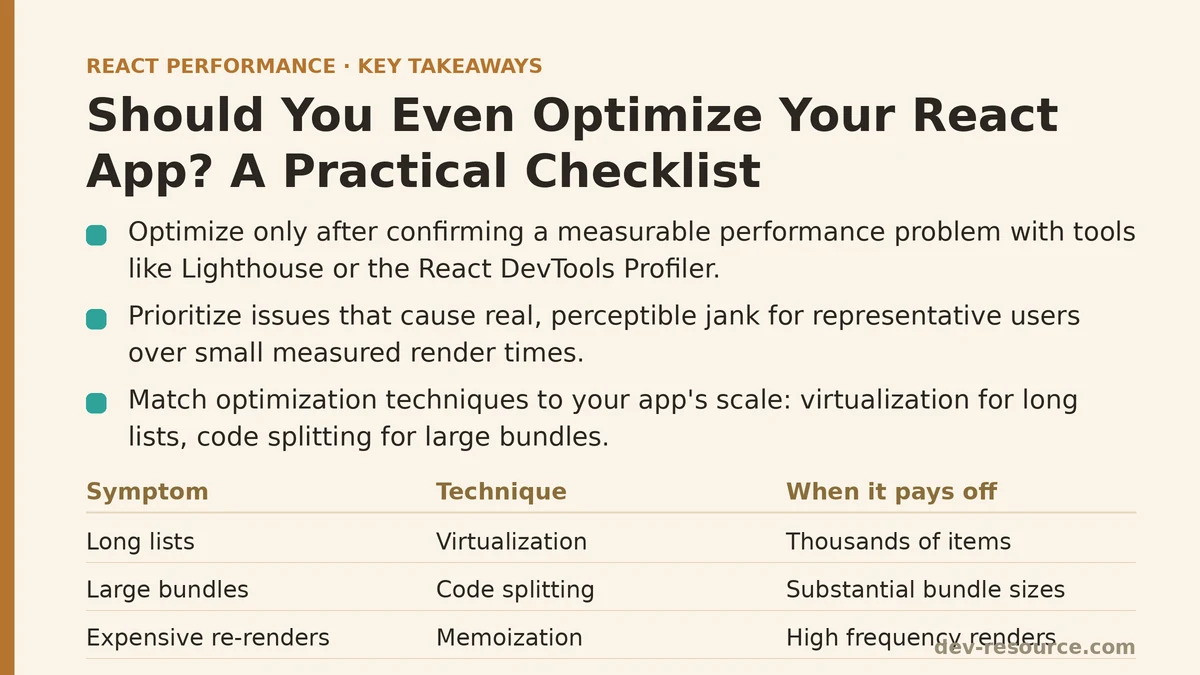
Many of the techniques covered throughout this site deliver their biggest measurable payoff at real scale — large lists with thousands of items, apps with substantial bundle sizes, components that render at high frequency. Smaller applications, simpler component structures, or modest data volumes often simply lack the underlying performance characteristics these techniques are built to address, so applying the corresponding optimization won’t produce a measurable benefit.
This connects to points made throughout our other guides — virtualization pays off most for long lists, code splitting pays off most for large bundles, memoization pays off most for expensive or frequently-triggered re-renders. If your application’s scale doesn’t match the scale where these techniques have shown a real benefit, that doesn’t mean the techniques themselves are wrong — it means applying them to your smaller-scale situation may not produce the kind of improvement that justifies the added complexity.
Step Four: What Is the Actual Cost of Adding This Optimization
Beyond whether a technique would help in theory, it’s worth being honest about the real implementation and ongoing maintenance cost. Code splitting adds loading-state complexity. Memoization adds dependency-array upkeep and the risk of the subtle bugs covered in our useMemo and useCallback guide. Virtualization adds a dependency and some implementation complexity around variable item heights or dynamic content.
Weighing that real cost against the real measured benefit — rather than treating optimization techniques as costless improvements to apply wherever they’re theoretically applicable — leads to better engineering decisions than optimizing for its own sake.
A Practical Decision Framework
Measure first, with real tools, confirming a performance issue exists before reaching for any specific fix, rather than optimizing on assumption or generic best-practice advice disconnected from your app’s measured characteristics.
Confirm the issue shows up in real user experience, not just as something technically measurable but imperceptible, which wouldn’t meaningfully improve user satisfaction even if addressed.
Check whether your application’s scale matches the scale where a given technique has a demonstrated benefit, instead of assuming every technique in general performance guidance applies equally regardless of your app’s particular characteristics.
Weigh the implementation and maintenance cost honestly against the measured benefit for your specific situation, rather than treating optimization as inherently and unconditionally worthwhile no matter the cost.
When Skipping Optimization Is the Right Call
For a fairly small application — simple component structures, modest data volumes, and no real performance complaints from actual users — the honest recommendation is often to skip most of the aggressive optimization techniques covered throughout this site entirely. Save that investment for if and when your app’s scale or measured performance characteristics genuinely call for it, rather than applying these techniques upfront on the assumption that more optimization is always better regardless of current need.
A Quick Reference Checklist
| Question | If No |
|---|---|
| Do real tools confirm a measurable performance issue? | Skip optimization for now |
| Does this issue affect real user-perceived experience? | Lower priority, even if technically measurable |
| Does your application’s scale match where this technique helps? | Technique likely won’t produce a measurable benefit |
| Does the measured benefit justify the implementation/maintenance cost? | Reconsider whether this specific optimization is worth pursuing |
What This Honest Framework Changed in Practice
Teams walking through this checklist have, in several cases, concluded that their application didn’t need the aggressive optimization work they’d initially assumed was necessary, redirecting that engineering effort toward other priorities instead. In other cases, this same measurement process confirmed a specific, real performance issue worth addressing, pointing the subsequent optimization effort at that confirmed issue rather than a broader, less targeted effort undertaken without this kind of upfront verification.
Related guides: Are Your React Dependencies Secretly Slowing You Down?, Automated Performance Regression Testing for React: A Practical Setup Guide, and Code Splitting in React: A Practical Guide to React.lazy and Suspense.
🔗 Recommended Reading
- React Performance Mistakes in Fintech Dashboards and How to Fix Them
- Lazy Loading Images and Components in React: A Step-by-Step Tutorial
- React Memoization: When and How to Use memo, useMemo, and useCallback
- Next.js App Router Performance Optimization for Beginners: A Step-by-Step Guide
- Measuring and Fixing React Re-render Performance: A Step-by-Step Walkthrough