📖 5 min read
In the ever-evolving landscape of web development, choosing the right architecture for your API is a pivotal decision that directly impacts application performance, scalability, and developer experience. Two dominant contenders in this arena are REST (Representational State Transfer) and GraphQL. While REST has been the cornerstone of API design for years, GraphQL has emerged as a powerful alternative, offering increased flexibility and efficiency. This article dives deep into a comprehensive performance comparison between GraphQL and REST APIs, specifically considering server-side logic and database architecture implications relevant to Python Django/FastAPI and Node.js backend development.
1. Understanding REST API Performance
REST APIs operate on a resource-based architecture, where each resource is uniquely identified by a URL. Clients interact with these resources using standard HTTP methods like GET, POST, PUT, and DELETE. While REST is widely understood and easy to implement, its performance can be hampered by over-fetching or under-fetching of data. This means clients often receive more data than they need (over-fetching) or have to make multiple requests to gather all required information (under-fetching).
For example, consider a REST API endpoint `GET /users/123` that returns a user's profile including their name, email, address, and a list of their blog posts. If a client only needs the user's name and email, it still receives all the other information, wasting bandwidth and processing power. Similarly, if a client also needs the details of the user's organization, it might have to make another request to `GET /organizations/456`, leading to multiple round trips and increased latency. In the context of a Django or FastAPI application, these unnecessary data transfers can quickly impact database query performance as more data is being serialized and sent over the network.
The performance limitations of REST become particularly apparent when dealing with complex applications that require diverse data combinations on the client-side. Traditional REST APIs often necessitate the creation of numerous endpoints, each tailored to a specific data requirement. This proliferation of endpoints increases server-side complexity, making maintenance and evolution more challenging. Furthermore, mobile applications, with their limited bandwidth and processing capabilities, suffer disproportionately from the inefficiencies of over-fetching in REST architectures.
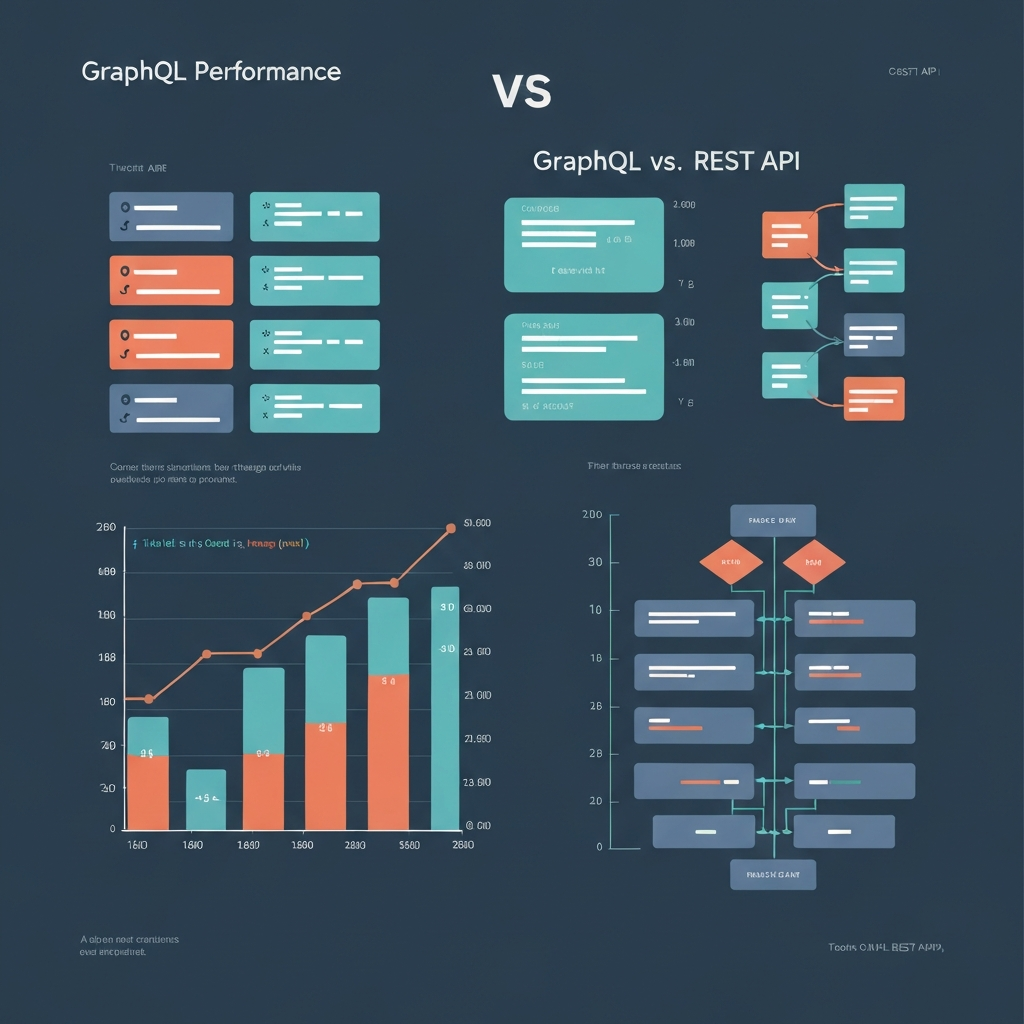
2. Analyzing GraphQL API Performance
GraphQL, in contrast, is a query language for APIs that gives clients the power to ask for exactly what they need and nothing more. Instead of defining multiple endpoints that return fixed datasets, GraphQL exposes a single endpoint and allows clients to construct specific queries requesting only the required fields. This eliminates both over-fetching and under-fetching, leading to significant performance improvements, especially in scenarios involving complex data relationships.
- Data Fetching Efficiency: With GraphQL, clients specify their data requirements in the query itself. For example, a client could request only the `name` and `email` fields from the `user` object using a query like `{ user(id: "123") { name email } }`. The server then resolves this query and returns only the requested data. This precision in data fetching reduces the amount of data transferred over the network, leading to faster response times and reduced bandwidth consumption. This is especially important for mobile applications and applications with limited network resources.
- Reduced Network Round Trips: GraphQL can fetch data from multiple resources in a single request. This eliminates the need for multiple REST API calls to different endpoints, reducing network latency and improving overall performance. For instance, a single GraphQL query could retrieve a user's profile, their recent blog posts, and the details of their organization. In Node.js environments, this can be crucial for optimizing data retrieval from microservices.
- Type System and Validation: GraphQL has a strong type system that defines the structure of the data and the available queries. This allows for compile-time validation of queries, preventing errors and improving the developer experience. The type system also enables efficient data serialization and deserialization on both the client and server sides. This results in more reliable and performant data processing. The introspection capabilities of GraphQL allow clients to easily discover the available data and queries, simplifying API exploration and integration.
3. Performance Benchmarks and Considerations
Optimizing database queries is crucial for both REST and GraphQL. Use appropriate indexing, caching, and query optimization techniques to minimize database latency and improve overall API performance.
While GraphQL offers inherent performance advantages, it's important to consider the nuances of implementation and the specific use case. Benchmarking the performance of GraphQL and REST APIs in real-world scenarios is essential to make informed decisions. These benchmarks should simulate realistic workloads and data complexities. Factors to consider include the number of concurrent users, the size of the data being transferred, and the complexity of the queries. In Python environments using Django or FastAPI, optimizing database queries is paramount. The Django ORM and SQLAlchemy (used with FastAPI) offer tools for query optimization, such as select_related and prefetch_related to reduce database round trips.
One key aspect to consider is query complexity. While GraphQL allows clients to request specific data, complex queries can put a strain on the server. Implementing query cost analysis and limiting query depth can help prevent malicious or inefficient queries from impacting server performance. Caching is another important consideration. Implementing caching at both the client and server sides can significantly improve performance by reducing the number of requests to the database. Tools like Redis and Memcached can be used to cache frequently accessed data.
Ultimately, the best choice between GraphQL and REST depends on the specific requirements of the application. For applications with complex data requirements and a need for fine-grained data control, GraphQL is often the superior choice. For simpler applications with well-defined data requirements, REST may be sufficient. Performance testing and monitoring are crucial for both architectures to identify bottlenecks and optimize performance over time. Load testing tools like Apache JMeter and Gatling can be used to simulate realistic workloads and measure API performance under stress.
Conclusion
In summary, GraphQL offers compelling performance advantages over REST in scenarios where clients require precise control over the data they receive. Its ability to eliminate over-fetching and under-fetching, combined with its support for fetching data from multiple resources in a single request, can lead to significant improvements in application performance. However, REST remains a viable option for simpler applications with well-defined data requirements and a need for ease of implementation.
The choice between GraphQL and REST should be driven by a thorough understanding of the application's specific needs and performance requirements. As applications become increasingly complex and data-intensive, GraphQL is likely to become the dominant API architecture. It offers better performance and a more efficient development experience. Future trends will likely focus on enhanced security features for GraphQL and improved tooling for query optimization and schema management.
❓ Frequently Asked Questions (FAQ)
When is REST a better choice than GraphQL?
REST is a better choice when dealing with simple applications that have well-defined data requirements and do not require the flexibility of GraphQL. For example, a basic CRUD (Create, Read, Update, Delete) application with minimal data dependencies might be effectively served by REST APIs. Additionally, if the development team has limited experience with GraphQL, the learning curve and initial setup costs might make REST a more practical option. REST’s widespread adoption and mature ecosystem also provide a wealth of tools and resources that can simplify development and deployment.
How can I optimize GraphQL query performance?
Optimizing GraphQL query performance involves several strategies, including query cost analysis, caching, and efficient data fetching. Query cost analysis helps prevent overly complex or resource-intensive queries from degrading server performance. Caching, both on the client and server sides, reduces the number of requests to the database. Data fetching can be optimized by using techniques like data loaders to batch and deduplicate database queries. Furthermore, ensuring proper indexing and query optimization at the database level is critical for minimizing latency.
What are the security considerations when using GraphQL?
GraphQL introduces several security considerations that are different from REST APIs. One major concern is the potential for denial-of-service (DoS) attacks through complex or deeply nested queries. Implementing query cost analysis and limiting query depth can mitigate this risk. Additionally, securing the GraphQL endpoint with authentication and authorization mechanisms is crucial to prevent unauthorized access to data. Input validation and sanitization are also important to prevent injection attacks. Regularly auditing the GraphQL schema and queries for vulnerabilities is recommended to maintain a secure API.
Tags: #GraphQL #RESTAPI #APIPerformance #BackendDevelopment #Python #Nodejs
🔗 Recommended Reading
- Building Resilient Event Driven Backend Systems Architecting for Scalability and High Availability
- Optimizing React Renders with Memoization Hooks A Deep Dive for Senior Frontend Developers
- Multi Tenant Database Design for Scalable Applications A Deep Dive into Python Django FastAPI Node.js Backends
- Managing Database Concurrency for Scalable Backends A Deep Dive into Python, Node.js, and RESTful APIs
- Achieving Smooth React UI with Advanced Hooks A Deep Dive into Optimization