📖 5 min read
The world of Python web frameworks offers developers a plethora of choices, each with its own strengths and weaknesses. When it comes to building robust and scalable backend systems, Django and FastAPI stand out as two of the most popular contenders. Django, with its mature ecosystem and batteries-included approach, has been a long-standing favorite for building complex web applications. FastAPI, on the other hand, is a relatively newer framework that boasts impressive performance and developer-friendly features. This article delves into a detailed performance showdown between these two frameworks, focusing on server-side logic and database architecture, to help you make an informed decision for your next project. We'll explore their key differences, benchmark their speed, and analyze their suitability for various use cases.
1. Architectural Differences and Core Design
Django, a high-level Python web framework, follows a Model-View-Template (MVT) architectural pattern. It emphasizes convention over configuration, providing a structured way to develop web applications. Django's ORM (Object-Relational Mapper) simplifies database interactions, allowing developers to work with database tables as Python objects. This approach streamlines development but can sometimes introduce performance bottlenecks due to the abstraction layer.
FastAPI, in contrast, is a modern, high-performance web framework for building APIs with Python 3.7+ based on standard Python type hints. It is built on top of Starlette and Pydantic, leveraging asynchronous programming to achieve impressive speeds. FastAPI's design prioritizes performance and developer experience, making it particularly well-suited for building RESTful APIs that require high throughput and low latency. Its automatic data validation and serialization capabilities further enhance developer productivity.
The architectural differences between Django and FastAPI significantly impact their performance characteristics. Django's MVT architecture and ORM, while beneficial for rapid development, can introduce overhead. FastAPI's asynchronous design and optimized data handling contribute to its superior speed and efficiency. Understanding these core design principles is crucial for choosing the right framework for your specific needs.
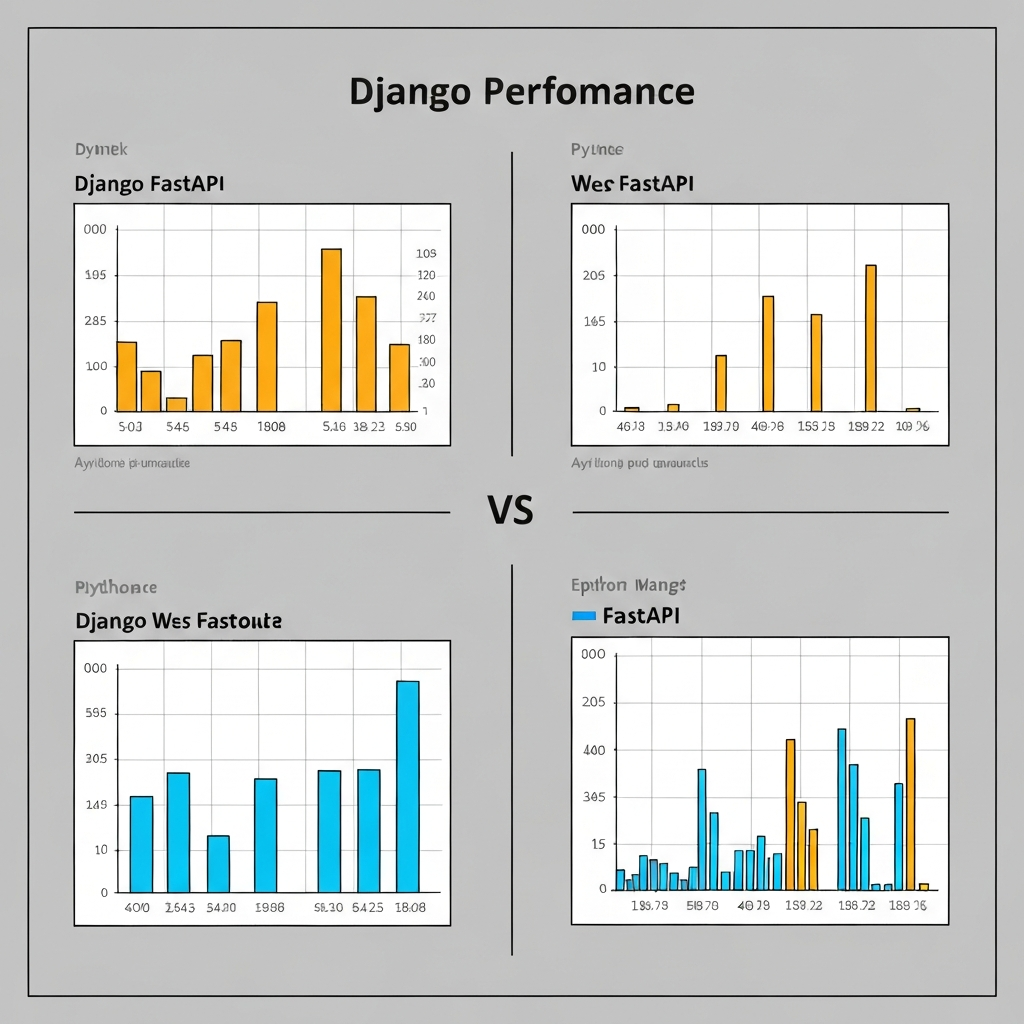
2. Performance Benchmarks- Speed and Efficiency
To objectively compare the performance of Django and FastAPI, we need to analyze benchmarks focusing on different aspects of web application performance. These benchmarks typically measure the number of requests per second (RPS) that a framework can handle, as well as the latency (response time) for each request. The type of workload—I/O bound or CPU bound—can drastically change these numbers.
- Hello World Benchmark: In a simple "Hello, World!" benchmark, FastAPI generally outperforms Django by a significant margin. FastAPI can handle significantly more requests per second and exhibits lower latency due to its asynchronous nature and optimized request handling. This is a very minimal test that doesn't represent real-world applications.
- Database Interactions: When interacting with a database, the performance gap between Django and FastAPI can narrow depending on the complexity of the queries and the efficiency of the database connection. However, FastAPI can still maintain an advantage, especially when using asynchronous database drivers. Django, by default, uses synchronous database drivers, which can limit its concurrency.
- Serialization and Validation: FastAPI's automatic data validation and serialization, powered by Pydantic, are highly optimized. This can lead to better performance compared to Django's manual serialization processes, especially when dealing with large datasets. Django REST Framework, while powerful, adds overhead compared to FastAPI's native approach.
3. Database Architecture and Optimization
Optimize your database queries! Profiling slow queries and adding appropriate indexes can dramatically improve performance, regardless of the framework you choose.
Database architecture plays a crucial role in the overall performance of any web application. Both Django and FastAPI offer tools and techniques for optimizing database interactions. In Django, the ORM provides a convenient way to interact with the database, but it's essential to write efficient queries. Using `select_related` and `prefetch_related` to reduce the number of database queries, indexing frequently queried columns, and optimizing database schema design are all critical for improving performance.
FastAPI, while not providing a built-in ORM, can be integrated with various ORMs and database libraries, such as SQLAlchemy. When using SQLAlchemy with FastAPI, it's important to leverage asynchronous database drivers to take full advantage of FastAPI's asynchronous capabilities. This allows the application to handle multiple database requests concurrently, improving overall throughput. Proper connection pooling and query optimization techniques are also essential for maximizing performance.
Ultimately, the choice of database architecture and optimization techniques depends on the specific requirements of your application. Regardless of whether you choose Django or FastAPI, a well-designed database schema and efficient queries are essential for achieving optimal performance. Profiling your database queries regularly and identifying potential bottlenecks is crucial for maintaining a responsive and scalable application.
Conclusion
In conclusion, both Django and FastAPI are powerful Python web frameworks suitable for building a wide range of backend applications. Django, with its mature ecosystem and batteries-included approach, is an excellent choice for complex web applications that require a robust feature set and rapid development. Its ORM simplifies database interactions, and its templating engine makes it easy to build dynamic web pages. However, Django's synchronous nature and ORM overhead can sometimes limit its performance, especially in high-traffic scenarios.
FastAPI, on the other hand, excels in performance and is particularly well-suited for building RESTful APIs that require high throughput and low latency. Its asynchronous design and optimized data handling contribute to its superior speed and efficiency. While FastAPI may require more manual configuration compared to Django, its performance benefits often outweigh the added complexity. As the demand for high-performance APIs continues to grow, FastAPI is poised to become an increasingly popular choice for backend development.
❓ Frequently Asked Questions (FAQ)
When should I choose Django over FastAPI?
Django is generally a better choice when you're building a large, complex web application with a significant front-end component and require features like user authentication, content management, and form handling out of the box. Django's mature ecosystem, extensive documentation, and large community make it easier to find solutions to common problems and accelerate development. If you're building a traditional web application with a server-rendered front-end, Django provides a comprehensive framework that simplifies many aspects of development. Furthermore, the built-in ORM can expedite database interactions, though optimization is always important.
When is FastAPI a better choice than Django?
FastAPI is a better choice when you're building a high-performance RESTful API, especially if you need to handle a large number of requests with low latency. FastAPI's asynchronous nature and optimized data handling make it significantly faster than Django for API development. If you're building a microservice architecture or need to integrate with other systems through APIs, FastAPI's speed and efficiency can be a significant advantage. Also, the automatic data validation and serialization features are extremely developer-friendly and can reduce coding time and errors when working with data from external sources.
Can Django and FastAPI be used together?
Yes, Django and FastAPI can be used together. One common approach is to use Django for the main web application and FastAPI for specific API endpoints that require high performance. This allows you to leverage the strengths of both frameworks. For example, you could use Django for the user interface and content management system, and use FastAPI to handle API requests for data-intensive operations. Another approach is to integrate FastAPI as a separate microservice that interacts with the Django application through its API.
Tags: #Django #FastAPI #Python #BackendDevelopment #API #Performance #WebFramework
🔗 Recommended Reading
- Building Resilient Event Driven Backend Systems Architecting for Scalability and High Availability
- Optimizing React Renders with Memoization Hooks A Deep Dive for Senior Frontend Developers
- Multi Tenant Database Design for Scalable Applications A Deep Dive into Python Django FastAPI Node.js Backends
- Managing Database Concurrency for Scalable Backends A Deep Dive into Python, Node.js, and RESTful APIs
- Achieving Smooth React UI with Advanced Hooks A Deep Dive into Optimization